EMUL2026
| March 25-26th, 2026 | London, UK
| March 25-26th, 2026 | London, UK
Recently, the Czech engineering and nuclear-research institution ÚJV Řež and Rolls-Royce SMR signed a new Memorandum of Understanding (MoU) aimed at deepening their collaboration on deploying small modular reactor (SMR) technology — both within the Czech Republic and internationally.
Far more than a routine partnership update, this agreement could become a milestone in taking SMR from “design and concept” to “industrialization, global supply chains, and commercial deployment.” For Europe — and potentially the world — the implications are profound.
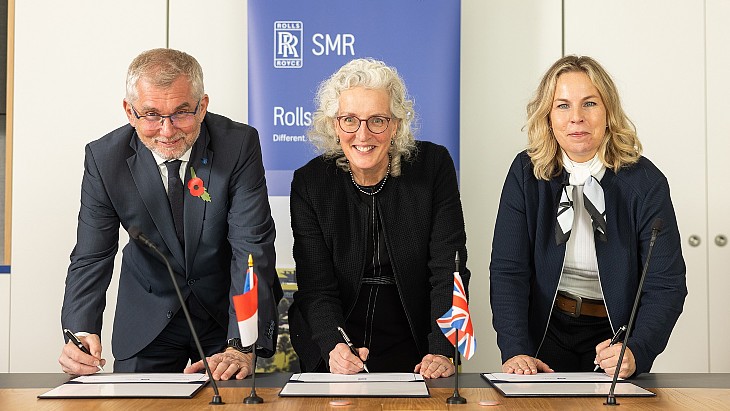
(Image: ÚJV Rez)
SMRs (Small Modular Reactors) embody the next generation of nuclear energy technology. Taking the Rolls-Royce SMR as an example:
Factory-built modules + on-site assembly: About 90% of reactor components are manufactured in controlled factory environments, then transported and assembled on site — reducing on-site complexity, shortening construction timelines, and lowering project risk.
Stable baseload power + long lifetime: Each 470 MWe unit can provide stable electricity to a million households for 60 years or more, delivering reliable, low-carbon baseload power.
Complementary to renewables: As intermittent generation from wind and solar grows, SMRs offer a stable backbone — essential for grid stability, energy security, and long-term decarbonization.
With global pressure to reduce carbon emissions and strengthen energy independence, SMRs are rapidly becoming a strategic choice — not a niche experiment.
Under the November 2025 MoU, Rolls-Royce SMR and ÚJV Řež agree to collaborate across a wide range of areas, including:
Nuclear-safety analysis
Design and engineering services
Testing and evaluation of critical components
Technical support for operations
Navigating licensing and regulatory requirements specific to the Czech Republic
Importantly, this is not a first-time partnership: previously, ÚJV Řež had a contract with Rolls-Royce SMR for component analysis, testing, and evaluation. The new agreement upgrades that to a full-cycle, system-level partnership, preparing the ground for actual SMR deployment.
Moreover, this opens the door for Czech industry — including manufacturers and qualified suppliers — to join a global SMR supply chain. Local companies may soon play central roles in building and exporting SMR reactors.
1. From Concept to Industry: A Pan-European SMR Ecosystem in the Making
Rather than exporting technology alone, Rolls-Royce SMR is helping build a distributed, multinational industrial ecosystem — where design, manufacturing, regulation, supply, deployment are integrated across countries.
2. Czechia as a Strategic SMR Hub in Europe
With over 60 years of experience, ÚJV Řež brings deep technical and scientific expertise. Partnering with Rolls-Royce SMR, Czechia could become not just a user, but a manufacturer and exporter of SMR technology across Europe.
3. Reduced Risk, Faster Deployment
Factory pre-fabrication + local testing + local supply + regulatory alignment significantly lowers the traditional barriers and risks of nuclear projects — offering a realistic, near-term path to clean baseload energy.
4. A Strategic Shift in Europe’s Energy Landscape
If Czechia succeeds, other European countries — especially in Central and Eastern Europe — may follow. SMR could become a key tool for energy security, decarbonization, and reduced fossil fuel dependence.
5. SMR as the Future Mainstream of Nuclear Power
With growing acceptance, participation of global suppliers, and standardization of design and supply, SMRs may evolve into the dominant model for nuclear energy — offering scalable, replicable, exportable solutions.
Of course, this path is not guaranteed. The transition from agreement to actual deployment faces multiple challenges:
Regulatory approval and licensing: Even with MoU, actual build-out must pass national and EU-level safety, environmental, waste-management, and public-consultation processes.
Public acceptance and societal trust: Nuclear energy remains debated — even SMRs must address concerns around safety, waste, long-term risk. Transparent communication and strong safety culture are essential.
Complex supply-chain logistics: International supply, transportation, modular assembly, quality control — each step adds complexity and potential bottlenecks.
Competition from renewables and evolving energy tech: As solar, wind, storage technologies continue to improve and become cheaper, SMRs must remain economically competitive.
Economic and geopolitical uncertainties: Energy policy shifts, regulatory changes, geopolitical tensions, market demand fluctuations — all could affect timelines, financing, and political will.
Given the growing urgency around decarbonization, energy security, and industrial revitalization in Europe, the newly strengthened partnership between ÚJV Řež and Rolls-Royce SMR could be the first step toward a broader SMR revolution.
If successful, Czechia may soon deploy commercial SMRs and build an export-ready supply chain — positioning itself at the center of Europe’s emerging SMR market.
As more countries follow suit, SMRs may transition from niche to mainstream — offering a stable, low-carbon, reliable baseload solution.
For investors, policymakers, energy planners, and industrial actors, SMR represents a long-term global opportunity — combining clean energy, industrial growth, supply-chain development, and strategic autonomy.
In the next 10 to 20 years, SMRs may no longer be just technological hope — but the backbone of Europe’s clean-energy, low-carbon, energy-secure future.