EMUL2026
| March 25-26th, 2026 | London, UK
| March 25-26th, 2026 | London, UK
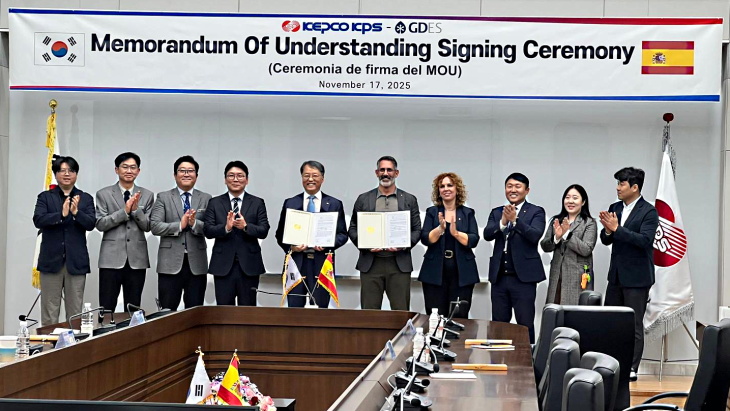
On 17 November 2025, Spain’s nuclear-services group GDES and South Korea’s KEPCO Plant Service & Engineering (KEPCO KPS) formalised a cooperation agreement to jointly deliver nuclear power-plant maintenance and operations services in Spain and France.
At first glance, this may appear as a routine business alliance — but it carries strategic importance that could reshape how nuclear power is operated, maintained, and sustained across Europe.
(Image: GDES)
GDES brings decades of experience in the European nuclear industry: more than 45 years participating in plant construction, maintenance, and decommissioning across Spain and other European countries. Its familiarity with European regulatory environments, supply chains, and local market conditions makes it a strong European anchor.
KEPCO KPS is a South Korean public company specialised in power-plant operation, maintenance (O&M), diagnostics and asset services. Established in 1974, it now operates globally (in about 25 countries), with a workforce around 5,800, and offers advanced maintenance and diagnostic services — including digitalised maintenance, predictive diagnostics, and critical asset management.
Their strengths are complementary: European regulation + market knowledge from GDES, and advanced technical maintenance capability + international operations experience from KEPCO KPS. This combination creates a competitive edge in providing nuclear-plant services in Europe.
The agreement (signed 17 November 2025) establishes a partnership for nuclear-power-plant maintenance and operations services in Spain and France, with shared know-how, resources, and capabilities.
For GDES, the deal enhances its value proposition: with KEPCO KPS’s technical know-how, GDES strengthens its service offering, positioning itself as a leading maintenance and lifecycle-service provider in the European nuclear market.
For KEPCO KPS, this represents a strategic push into mature European nuclear markets — not as a reactor builder, but as a provider of high-quality operation, maintenance, diagnostics, and asset-management services. This expands their global footprint beyond Asia, Africa, or emerging markets.
From “Build-and-Forget” to “Operate-Maintain-Extend-Service”: A Shift in Nuclear Value Chain
Historically, nuclear projects emphasised construction and power generation. But as European nuclear fleets age, demand is growing for high-quality maintenance, lifecycle management, long-term operation, and possibly decommissioning or extension services. The GDES–KEPCO KPS alliance is precisely oriented to this emerging demand.
Cross-Regional Supply Chain & Knowledge Transfer — A New Model for Nuclear Services
This cooperation brings together Asian technical excellence with European regulatory and market familiarity — a hybrid model that could set a precedent. European operators may benefit from state-of-the-art maintenance technologies (digital diagnostics, predictive maintenance, advanced asset management) imported via this partnership. For KEPCO KPS, it’s an avenue for internationalising their service standards and entering mature markets.
Strategic Relevance for Spain & France
In Spain, although there were plans to phase out nuclear, recent political shifts have revived interest in extending the lifetime of existing reactors — meaning maintenance and lifecycle services demand could increase.
In France — a nuclear-heavy country with dense reactor fleet — the need for high-quality maintenance, lifecycle support, and perhaps upgrades will remain high. The GDES–KEPCO KPS alliance could bring reliable, professional services to meet these needs.
The New Reality: Nuclear as a Long-Term Service Industry, Not Just Power Generation
If nuclear power evolves into long-term asset management — involving maintenance, lifecycle extension, upgrades, decommissioning, waste handling — then companies specialized in operation & maintenance (O&M) and asset services may become as critical as utilities or reactor builders. This alliance may be an early step toward the formation of an international nuclear-service industry.
Policy & Public Opinion in Europe: Nuclear energy remains controversial in parts of Europe; policy shifts, retirements, or accelerated decommissioning may reduce demand for maintenance services.
Regulatory Complexity & Compliance Challenge: Providing services across national boundaries requires mastering and adhering to different regulatory regimes (safety, environmental, waste, licensing, public consultation), which can be complex and time-consuming.
Competition with Established Local Players: Europe already has some experienced nuclear-service providers; the alliance must demonstrate superior quality, reliability, and cost-effectiveness to win contracts.
Demand Uncertainty: If nuclear phase-out accelerates or renewables plus storage become dominant, demand for long-term maintenance and lifecycle services may decrease.
The GDES–KEPCO KPS cooperation may be more than a business deal — it could be emblematic of a structural evolution in nuclear energy: from “build once, run and forget” toward “operate, maintain, service, extend, internationalize.”
If successful:
More global maintenance/service companies may enter European markets — bringing advanced maintenance technologies, digital diagnostics, predictive maintenance, and lifecycle management.
The nuclear industry could increasingly treat reactors as long-term industrial assets — with lifecycle management, performance monitoring, upgrades, decommissioning, and waste management services becoming standard.
For utilities and regulators, this could improve safety, reliability, reduce risk, and extend reactor life — helping nuclear remain viable in European energy mixes.
For investors and service providers, this could open a new, stable, long-term market: nuclear-service-as-a-business, rather than just reactor sales or construction.
In short: this alliance might mark the beginning of a globalized, service-oriented nuclear industry — where reactors are not only built, but carefully managed over decades, across borders, with specialized service providers ensuring safety, reliability, and longevity.